

Don’t Let a Big Bonus Fool You: Choose the Higher Base Salary in Korea
Comparing Korean job offers? Learn why a higher base salary (기본급) in Korea is always better than a big bonus, affecting your overtime, severance, and next job offer.


Imagine you have two Korean job offers on the table, and they both advertise a total annual compensation of 50 million KRW.
- Offer A: 40M Base Salary + 10M Bonus
- Offer B: 45M Base Salary + No Bonus
If you are like most, the 10M bonus sounds incredibly tempting. However, accepting Offer A could be a mistake over time. Understanding how Korean payroll works is crucial to maximizing your earnings. In the Korean corporate system, a higher base salary (기본급) quietly wins almost every time.
Here are the hidden reasons why your base salary is far more important than a bonus.
Also check out: "How to Avoid Overworking Companies”
1. Base Salary Compounds Everything in Korea
In Korea, your 기본급 (base salary) is not just your monthly paycheck; it is the foundation for almost all of your legal financial benefits.
Your base salary directly determines:
- Your legal hourly rate for overtime pay
- Your payout for unused annual leave (연차 수당)
- The average wage used to calculate your mandatory severance pay (퇴직금)
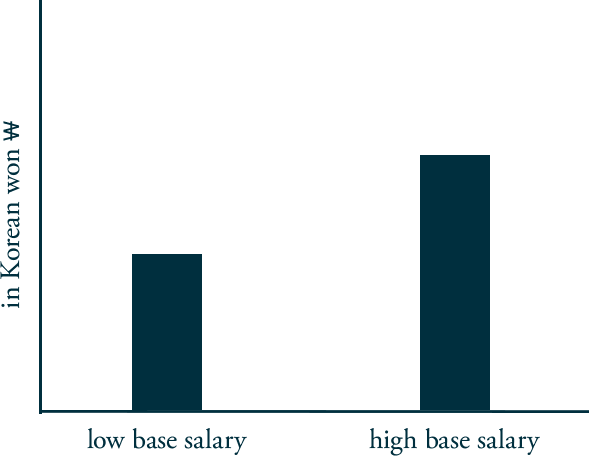
Let us break down the math. If you take the 40M base, your internal "hourly rate" calculated by the company is lower. If you take the 45M base, your hourly rate is significantly higher.
Quick Overtime Example:
Imagine you work 10 hours of paid overtime in a month.
- 40M base: You earn approximately 192,000 KRW in overtime pay.
- 45M base: You earn approximately 216,000 KRW in overtime pay.
- The Difference: That is a 24,000 KRW difference per month. Multiply that by 12 months, and you are leaving over 288,000 KRW on the table in overtime.

2. The Bonus is Riskier Than You Think
When you see a big bonus on a job offer, you must verify exactly what type of bonus it is. In Korea, bonuses generally fall into two categories:
- 고정 상여금 (Fixed Bonus): This is mathematically guaranteed in your contract and usually paid out on major holidays like Chuseok and Seollal.
- 성과급 (Performance-Based Bonus): This is highly conditional.
If that 10M bonus is tied to 성과급, it is not guaranteed. If the company misses its annual financial targets, or if your specific team underperforms, that 10M can shrink or disappear. Even if your personal performance is good, a bad year for the company means you lose out.
3. Higher Base Equals Higher Next Job Offer
This is the compounding effect that expats rarely talk about. When you eventually switch jobs in Korea, recruiters will always ask for your current 기본급 (base salary), not your "총연봉" (total marketed compensation).
If you accepted Offer A (40M base), you will enter your next negotiation positioned for a 44M to 48M offer. But if you accepted Offer B (45M base), your new baseline is much higher. You will be negotiating your next role starting from 50M to 55M. Even though both of you earned a "total" of 50M this year, the person who prioritized base salary secured an advantage for their long-term career.
Summary and Next Steps
On paper, a job offer with a bonus might seem tempting. But when you factor in Korean labor laws, overtime calculations, severance pay, and future job negotiations, a higher base salary is the winner.
Negotiate to maximize your 기본급, protect yourself from performance-based risks, and set yourself up for higher earnings in your next role.
Have you ever negotiated a base salary in Korea?
Share your experiences or questions in the KOVE community!