

How to Spot Overworking Korean Companies
Avoid working for free in Korea. Learn how to spot overworking companies, understand the inclusive wage system (포괄임금제), and protect your overtime pay.

Let us say you took an exciting new job at a Korean startup. The team is great, but three months in, you realize you are working an extra 20 to 30 hours a week. Despite the late nights, you still get the exact same monthly salary. When you ask HR about your overtime pay, the company casually says, "Overtime hours are all included in your salary." Without any clear hourly guidelines, you quickly realize you are overworking for free.
If this sounds familiar, you are not alone. Wage violations are incredibly common, and navigating Korean labor laws as an expat can feel overwhelming. Recent government inspections revealed that unpaid overtime and wage theft remain some of the most frequent labor violations at Korean companies.
I have seen countless talented professionals burn out because they did not understand their contracts. Today, I will explain exactly how companies abuse the system and share three golden rules to help you avoid them.
Also read, Ministry of Employment and Labor Official Site
The Inclusive Wage System
Currently, over 60 percent of foreigners in Korea experience wage violations. These issues are mainly linked to a specific legal concept called 포괄임금제 (Pogwal Imgeumje), which translates to the Inclusive Wage System.
In Korea, the inclusive wage system allows employers to include a fixed overtime allowance directly into your base monthly salary. This is the exact opposite of 비포괄임금제 (Non-inclusive Wage System), where every single hour of overtime is calculated and paid separately from your standard salary.
Neither policy is illegal. In fact, many legitimate companies use the inclusive system for roles where tracking exact hours is difficult. However, abusive companies often use this system as a tactic to force you into an extra 10 to 20 hours of unpaid overtime each week. To protect yourself, always remember the "3 Cs" when reviewing your contract: Clarity, Consent, and Coverage.
1. Clarity
Companies must clearly explain to employees exactly how their overtime is calculated. You should always ask for this breakdown during the interview or before signing the contract.
A trustworthy company will provide a transparent mathematical breakdown of your pay. A good example of a clear overtime calculation looks like this:
- 기본급 (Base Salary): 2,800,000 KRW
- 월 20시간 OT (20 Hours OT): 519,000 KRW included (calculated as Base hourly rate 17,300 KRW x 1.5 overtime multiplier x 20 hours)
- Total Monthly Salary: 3,319,000 KRW
This breakdown explicitly states that your "included" overtime is strictly limited to 20 hours. Both you and the company must have a clear, mutual understanding of these expectations. If a company just writes "Overtime included" without any specific numbers, consider that a massive red flag.
2. Consent
Clarity alone is not enough. Companies must get explicit consent from you in writing after having explained the overtime expectations clearly.
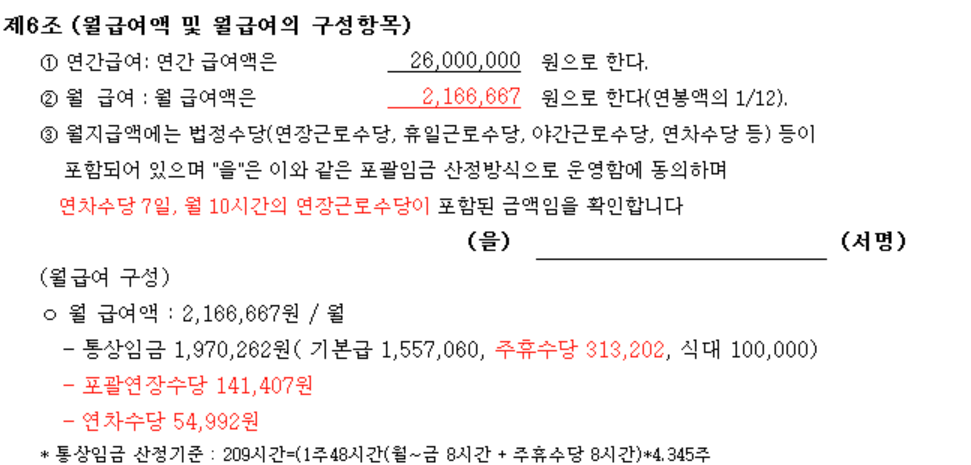
When you read through your Korean labor contract, look closely at the fine print. The document must state something very specific to make the inclusive wage system legally binding. You will typically see a clause that looks like this:
"월 임금에는 근무상황과 업무특성을 반영해 산정한 고정적인 시간외근무에 대한 수당이 포함돼 있으며, 근로자는 이에 동의한다."
This translates to: "The monthly wage includes a fixed overtime allowance calculated based on the work situation and job characteristics, and the employee agrees to this."
If you sign a contract containing this exact phrase, you are legally agreeing to provide those included overtime hours. Never sign unless you are completely comfortable with the number of hours specified.

3. Coverage
Here is the most important secret that overworking companies do not want you to know. Even under the inclusive wage system, companies must cover your overtime pay if your hours go beyond the specified limit in your contract.
For example, let us say your contract explicitly includes 20 hours of overtime per month. If a major project launches and you end up working 30 hours of overtime in a single month, the company cannot just say "it is included." They are legally required to pay you for those extra 10 hours at the standard overtime rate. You are entitled to those extra 10 hours by law. If they refuse to pay, that is wage theft.
Always keep a personal log of your daily working hours. Having a written record is your best defense if you ever need to file a claim with the labor board.
Protect Your Korean Career
Do not let abusive employers ruin your professional experience in South Korea. By keeping the 3 Cs in mind, you will build a much stronger radar for spotting overworking companies before you accept an offer.
- Clarity: Demand a clear mathematical breakdown of your base pay versus your overtime pay.
- Consent: Check your contract for the specific written clause agreeing to fixed overtime.
- Coverage: Track your hours closely and demand extra pay for any time worked beyond your agreed limit.
Have you ever dealt with confusing overtime rules at a Korean company?
Share your personal experiences or any questions you have in our KOVE community! We want to help you rebuild your career the right way.