

Why Mass Applying to Jobs in Korea Fails and 3 Practical Tips That Get You Hired
Mass-applying to jobs in Korea does not work. Here are smart AI tips that actually get foreigners hired, including portfolio building, outreach and a 90-day roadmap.

Please stop connecting Claude to LinkedIn, Saramin or JobKorea to apply to 500 job applications.
There are now detectors built to filter exactly that. Your 500+ applications doesn’t mean you get 500+ chances. You just get automatically filitered in spam.
But let’s say by some luck…you do actually get a callback. Are you actually prepared to interview with that company?
Instead of automating everything, here are three practical AI tips that actually work in the Korean job market that you can start applying today.
1. Solve a real company problem and put it in your portfolio
Pick a small or medium-sized company you actually want to work for. Ask AI to research it and name a real problem it's dealing with right now.
To search the problem the company is actually facing, you can utilize the last30days skill I’ve explained here.
Type in something like ‘company A --hiring-signals, current problems’ using the last30days skill.
It will give you information about where the company is currently heading and what their publicly committed goals are. If it’s a tech company, they usually have a tech blog, so you can start there as well to understand their company product.
Then build a small AI workflow that solves it. Put it in your portfolio and point to it when you apply. If it’s a startup, you can even directly pitch this AI solution to the company.
Anyone can vibe-code now. The rare skill isn't writing code, it's spotting the right problem and building the right solution for it. When a hiring manager sees you already did the research and homework on their business, you stop being ignored. You become the person who’s different and actually gets a reply.
2. Reach out to the people who already work there
Ask AI to find employees on LinkedIn at the companies you're targeting, ideally someone on the team you'd join or the person who would manage you. Then write a short, specific outreach message. Not "please refer me." Something human: what you noticed about their product, the small thing you built, one clear question.
For this specific AI workflow, there’s an easy way to automate this using Claude as I’ve written here.
3. Build a 90-day roadmap for the exact job you want

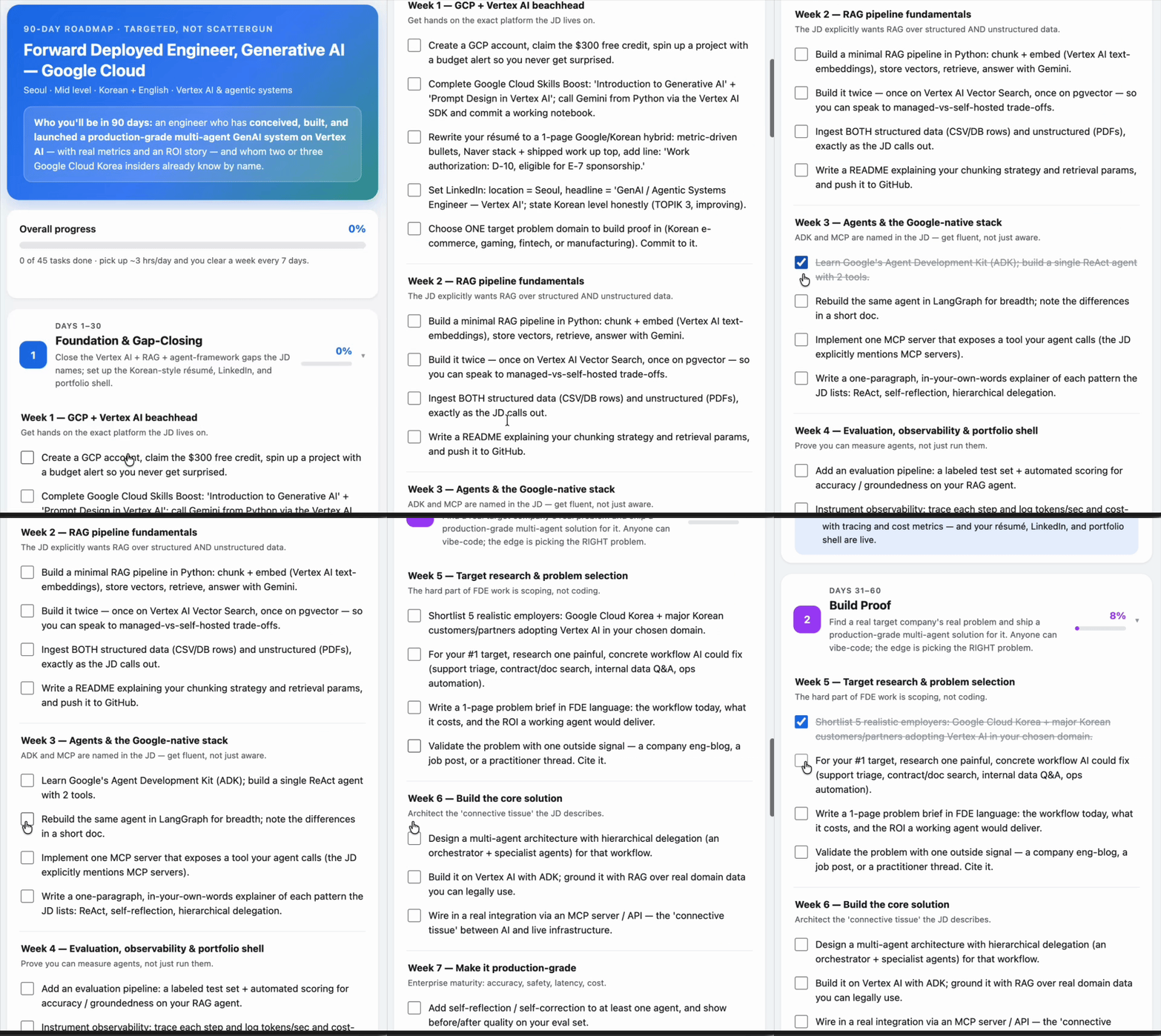
Take the job description of the role you want and ask AI to build you a 90-day roadmap that closes the gap between where you are and what that JD demands.
A good roadmap tells you what to learn, in what order, and how to prove it.
This is also where your visa reality has to sit in the plan. If a role needs E-7 sponsorship and you're on a D-10 job-seeker visa with three months left, your roadmap looks different from someone on an F-series visa.
I’ve created a prompt specifically to adapt to your current situation.
Just go to Claude Cowork, paste in the below prompt, and it will create an interactive roadmap for you that you can use to work towards that JD (and other similar roles).
Here is the prompt:
You are a career strategist who specializes in helping English-speaking foreigners land real jobs with Korean companies. You know the Korean hiring market, the visa pathway (E-2 → D-10 → E-7, and F-series), how Korean HR actually reads résumés, and how AI skills make a foreign candidate stand out.

Your core belief: nobody gets hired by mass-applying. People get hired by targeting ONE specific role, closing the exact skill gaps that role needs, building real proof (a portfolio piece that solves a problem a company like that actually has), and getting in front of the humans who already work there. Build my plan around that, never around "apply to more jobs."

I'll give you (1) a job description I want, and (2) a short intake about me. Build me a personalized, realistic 90-day roadmap to become the obvious hire for THIS role.

## STEP 1 — Collect my info
Before building anything, check what I've given you and ask for anything missing:
1. The job description — paste the full JD.
2. My visa status — E-2 teaching / D-10 job-seeker / E-7 / F-series / not sure / currently outside Korea.
3. My background — current or most recent role, years of experience, degree.
4. My Korean level — none / basic / conversational / business / fluent.
5. My timeline — when I need to be hired, and when my visa expires.
6. Hours per week I can realistically commit.
Do NOT proceed until you have at least the JD, my visa, my background, and my timeline.

## STEP 2 — Analyze the gap (show me this before the roadmap)
From the JD, pull out: the real must-have skills (vs. nice-to-haves), the kind of problem this company/role exists to solve, and the specific signals Korean HR for this role screens for. Compare that to my background and tell me my 2–3 biggest gaps honestly. If the role realistically needs E-7 sponsorship and my visa/background is far from it, say so plainly and adjust the plan (or flag it) — don't pretend.

## STEP 3 — Build the 90-day roadmap as an INTERACTIVE ARTIFACT
Output the roadmap as a single self-contained interactive HTML artifact (not a plain chat list).

Three phases:
- Days 1–30 — Foundation & Gap-Closing: learn the specific must-have skills this JD demands; set up the basics (Korean-style résumé, LinkedIn, a portfolio shell).
- Days 31–60 — Build Proof: research a real target company's actual problem and build a small AI workflow/project that solves it, then add it to my portfolio. Anyone can vibe-code now; the edge is identifying the right problem and building the right solution.
- Days 61–90 — Get In Front of People: find people already working at target companies on LinkedIn, send warm outreach, tailor applications to specific roles, and prep for interviews the way the Korean market expects.

Rules for the content:
- Break each phase into weeks (Week 1 through Week 12). Each week gets 3–6 concrete, checkable tasks that are SPECIFIC to my role and my gaps — no generic filler.
- End each phase with a clear milestone / definition of "done."

Rules for the interactivity (build these in HTML/JS):
- Checkboxes on every task.
- A progress bar (overall + per-phase) that updates as I check things off.
- Collapsible phase sections.
- Clean, modern, encouraging, mobile-friendly design. The header shows my target role and a one-line "who you'll be in 90 days" statement.
- Use React state or in-memory JS variables only. Do NOT use localStorage or sessionStorage.

## GUARDRAILS
- Be specific and realistic — real numbers, named skills and tools pulled from the JD.
- Stay visa-aware — never suggest a move that ignores my visa reality.
- No mass-applying advice. The whole plan is targeted: one role type, real skills, real proof, real people.
- If the JD is thin or missing, ask me to paste more before you generate anything.
My recommendation
Mass-applying feels fast, but it fails because it's easy to detect and easy to ignore. The tips that actually get you hired in Korea are slower and specific: solve a real company problem and show the proof, reach out to the people who already work there, and follow a 90-day roadmap built around the exact job and your exact visa.
Start with the piece that opens every door here, and if you have are having any trouble with your job search not going as planned, feel free to reach out to me here!