

How to Get a Job in Korea With a Resume Gap: Two Things That Actually Work
Learn how to get a job in Korea with a resume gap by building two things hiring managers respect: a freelance company and a real AI automation project.

People keep asking me how to get a job in Korea with a resume gap of one or two years. Here's the part nobody wants to hear: the gap isn't the problem, your explanation of it is.
I took a 12-month career break while moving from Canada to Korea, and still landed a six-figure role here. Not because I hid the gap or explained it through "personal growth." I filled it with two things that actually show you didn’t just waste time. Here’s what you can do as well, starting today.
Tip One: Freelance as a Company, Not a Person
"I freelanced" can sometimes be interpreted differently by Korean employers, often times in the negative sentiment especially as a foreigner. Instead, incorporate yourself as a company so the profile reads as "I ran a business."
If you're a developer, incorporate a web development agency that helps local businesses build apps and websites, then put that on your resume as your business startup/consultancy during the gap. This works just as well for marketing and business development. A marketer becomes the founder of a small content studio. A BD person operates under a consultancy who tightened up processes for a couple of clients. You're not lying, you’re switching up the angle from a business perspective, which is a skill that not a lot of competitor candidates will have for the same role.
Laws will vary for each country, but usually if you’re self-employed and quite small (under ~$100k in revenue), the process of getting a company and a business registration number will not be too difficult. In Korea, sole proprietor registration is handled through the National Tax Service’s Hometax portal, and foreigners on an eligible visa can register a business here too.
Tip Two: Build a Real AI Automation Project; No Coding Needed
Instead of saying "I learned about AI," you should start saying, I built something that solved a real problem for a real Korean business. So let me hand you a specific AI automation project you can copy, starting today, even if you don’t have any technical knowledge.
First, think about a real problem local businesses in Korea might potentially face. After doing my own research, I found that many businesses struggle with creating content because they would rather spend that time actually focusing on their business.
Specifically, I had an acquaintance who was running a local food business, but every time a new menu came out and they wanted to film the content, the process of translating that food item into a SEO-friendly and foreigner-friendly description with captions can be a lengthy process.
Sure you can do this with ChatGPT with a couple of prompts, but what if you actually gave them an app to streamline this process, saving them time?
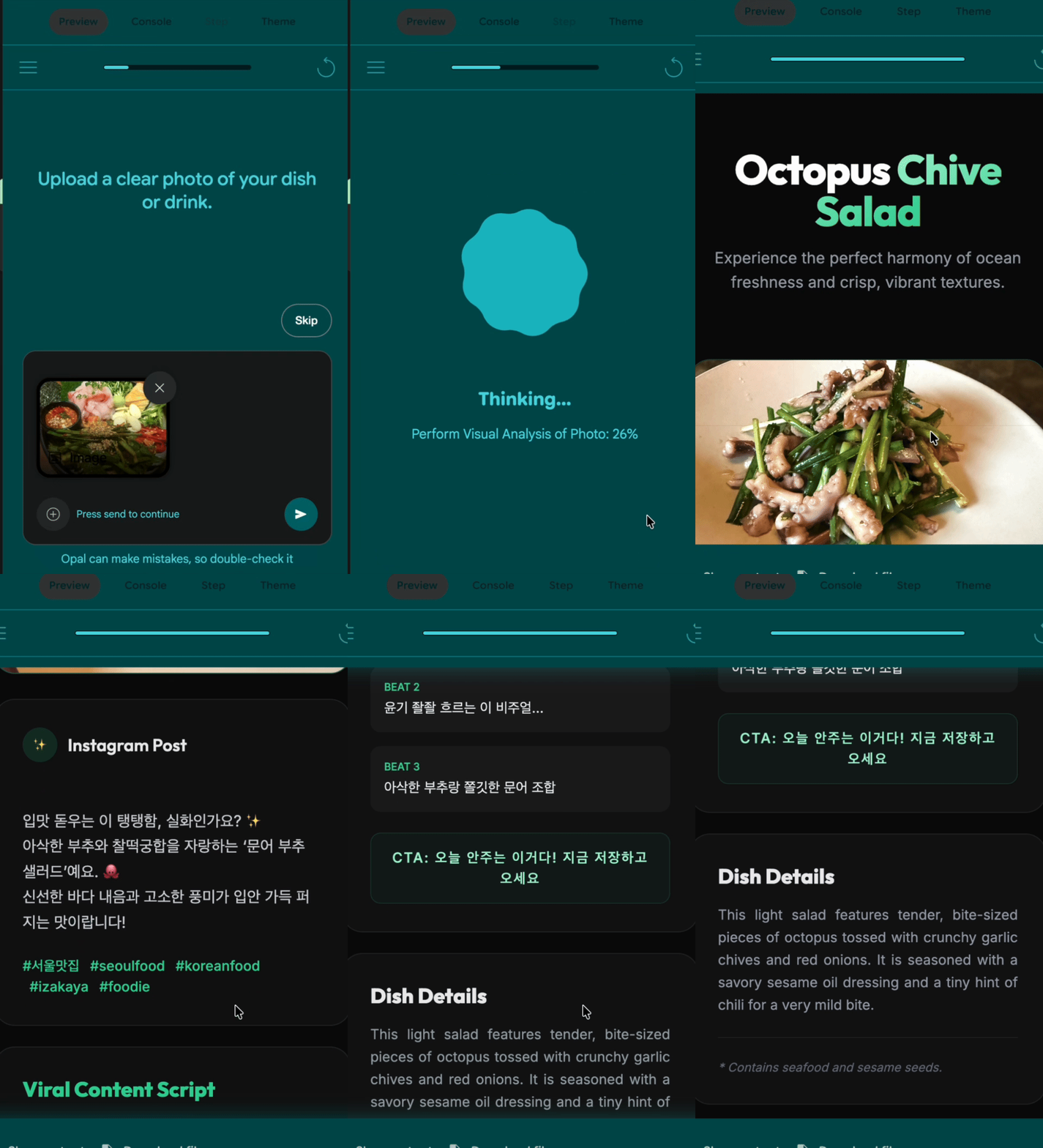
For example, the small business owner can take a photo of the new menu item via an app, and it will instantly generate 1) Instagram caption 2) Viral ready script 3) English-ready descriptions.
One input, a week of content. That's the AI automation workflow.
Here’s a demo output of the AI automation solution below 👇

The tool: start with Google Opal
For the past two years, the default answer to "what do I build this Ai automation in" was n8n. n8n is a powerful AI friendly automation tool, but the learning curve is significant especially if you’re not a developer. Start somewhere easier, for those who are still learning AI and adapting to the tech.
Google shipped a more beginner-friendly, free option called Opal, and it turns an English description into a working AI mini-app, handles all the hosting, and runs everything on Google's Gemini models. You describe the logic, it builds the visual flow, you edit steps by typing instead of coding. It's free, with no usage caps or hosting fees while it's in its Labs phase (as of writing in June 2026), and it can read images and write text in the same flow, which is exactly what this project needs.
Even better, once your app works, Opal hosts it and gives you a shareable link. You hand the local food business owner that link, they drop in a photo, they get content back. That's a clean solution to deliver to a client and a clean thing to show in an interview.
The Setup
- Go to Google Opal and create a new project
- Input the appropriate prompt in the textbox to build out this workflow. Think for a moment what logic it needs to handle.
- You can utilize my starter prompt to start. This prompt will set up the basics necessary for getting the logic going, but you need to still tweak it to actually deliver good-quality output. Remember, always start with AI, but you need to evaluate critically on your own the output results, so you’re not just letting AI blindly do all the work.
Here is the prompt to input into Google Opal:
Build a mini-app called "Menu Content Kit" for small food business owners in Korea.

INPUT:
- One image upload labeled "Menu Item Photo" with the helper text: "Upload a clear photo of your dish or drink."

STEP 1 — Visual Analysis:
Add a step called "Perform Visual Analysis" that uses a Gemini vision-capable model to look at the Menu Item Photo, then identify the dish, its likely ingredients, and its visual appeal. Pass this analysis to the next three steps.

STEPS 2, 3, 4 — run these three in parallel, each using the Menu Item Photo and the Visual Analysis:

- "Instagram Caption Generator": You are a social media manager for a trendy food spot in Korea. Write one Instagram caption for this menu item with a strong first-line hook, 2 to 4 short warm lines, one sensory detail, and 5 to 8 mixed Korean/English hashtags.

- "Script Generator": Write a short-form video script (Reels / TikTok / Shorts) for this menu item, 20 to 30 seconds, formatted as on-screen beats: HOOK (0-3s), BODY (3-20s) with 2 to 3 quick beats and what to film, and a CTA. Keep language spoken and simple.

- "English-description": Write a short, foreigner-friendly English description of this menu item for tourists and expats in Korea. 2 to 3 sentences, explain unfamiliar ingredients, note if spicy/vegetarian/allergens.

OUTPUT:
Add a final step called "Output" that takes the Instagram Caption, the Script, and the English description, and generates a single, cohesive HTML webpage that presents all three outputs in clearly labeled sections the owner can copy from.
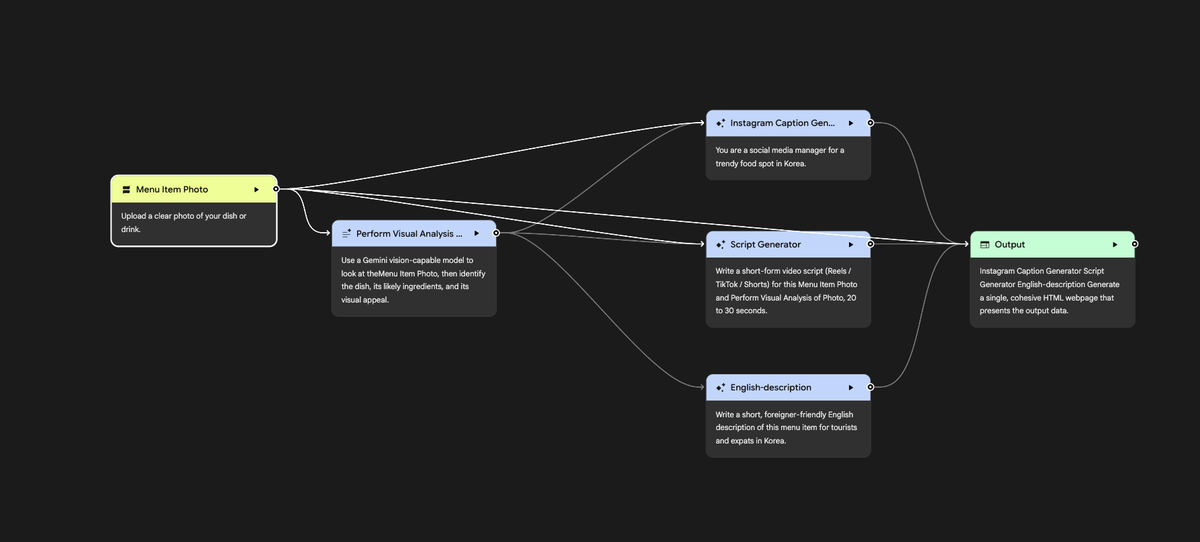
You should have something like the above, if not, feel free to play around with the tool to set it up. You can also find my starter Google Opal workflow here, duplicate it to your own project and start building.
When you are ready to level up
Once the concept clicks, two tools take you further. You can take this to n8n when you're running this for several clients and want it cheap and fully under your control. Or, you can even vibe-code this into a working app by exporting it from Opal and instructing Claude to help out.
Why this helps you
During the interview, you say to aa Korean employer: "Korean small business owners already lose about 10% of their day just to film content that actually shows up on LLMs and is SEO-friendly. I built a tool that turns one new menu photo into a week of platform-ready SEO-friendly content, so a small shop can keep up without the time spent wondering." Frame it from the angle of the job you actually want, marketing, ops, BD, tech, and the gap starts to make more sense.
Put Both Tips Together Before You Apply
So, two tips that turn a Korea resume gap from a liability into an interesting explanation for Korean employers. First, register your freelance work as a real entity so it reads as a business, not an actual break. Second, build one concrete AI automation that solves a business problem for a local business, and present it through the lens of the role you're aiming for.
If you need more help with your career in Korea, reach out to me here!