

How To Check If A Korean Company Is About To Do Layoffs
Before you accept a job offer in Korea, learn how to use the free DART database to spot red flags that could signal upcoming layoffs. Here's three signs to look out for.

Before you work for a company in Korea, ask yourself: is this company actually stable?
The good news is that you can check these warning signs yourself using one completely free, official government tool. Let me show you how to find it and give you the three red flag signs to watch out for.
What is DART and Why Does it Exist?
DART (전자공시시스템) is Korea's official corporate disclosure system, operated by the Financial Supervisory Service (FSS). By law, listed and major Korean companies must publicly file their official documents here. That means the data is factual and based on real numbers.
The three most important report types you will find:
- 사업보고서: Annual Business Report (the most comprehensive)
- 분기보고서: Quarterly Report (tracks progress between annual reports)
- 감사보고서: Audit Report (an auditor's opinion on the company's finances)
Note: DART works best for KOSPI/KOSDAQ-listed companies. If your target company is a smaller SME or an unlisted startup, check out the SMINFO guide instead.

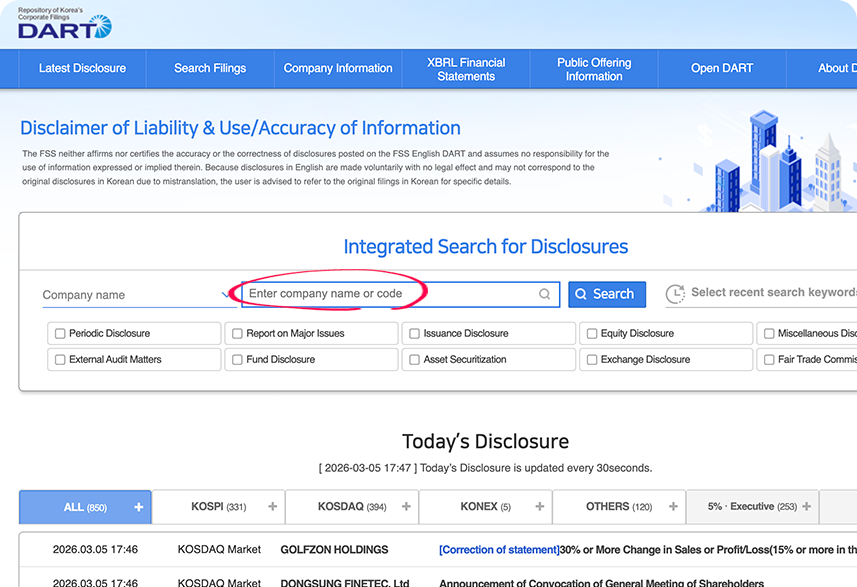
How to check their annual report
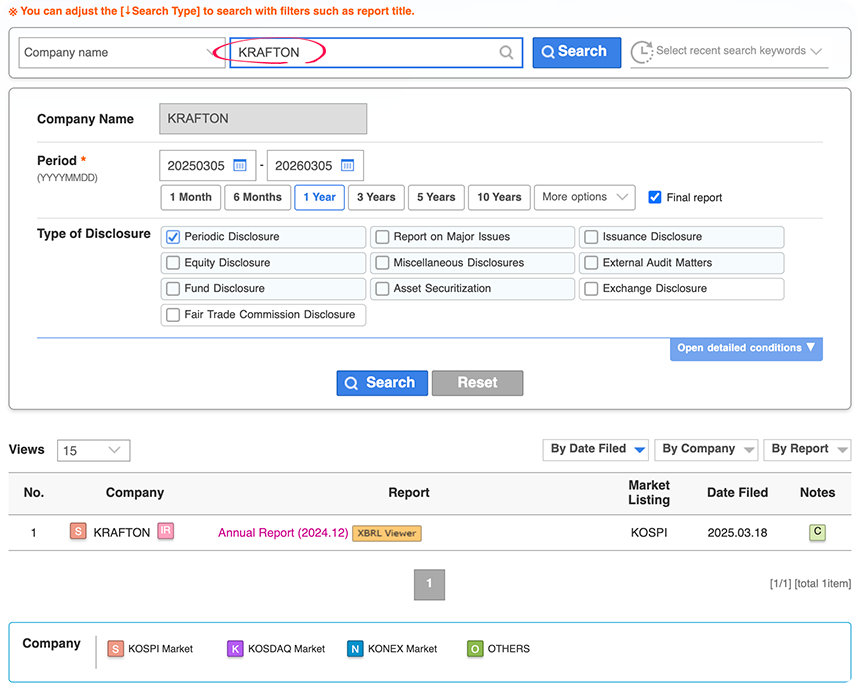
Enter a company (I’m using KRAFTON, a game company that made PUBG) as an example. Check on “Periodic Disclosure” and once you press enter, you will be able to see their annual reports. Click on the latest year.

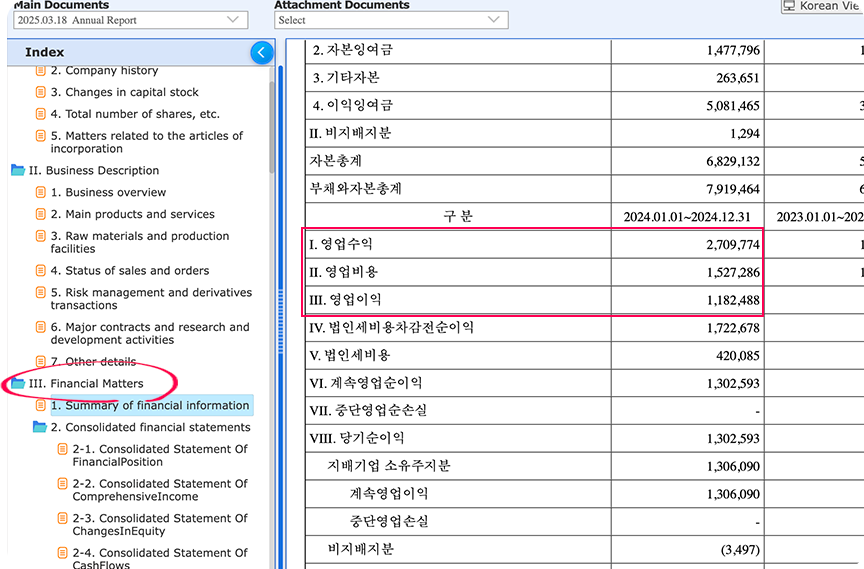
Red Flag 1: Financials
The first reliable indicator of upcoming layoffs is a company's finances. Navigate to III.1. Summary of financial information
What to look for:
- Growing year-over-year
- Consistently positive net profits
- Positively operating cash flow
- Debt levels are stable or decreasing

Red Flag 2: Weak Risk Management
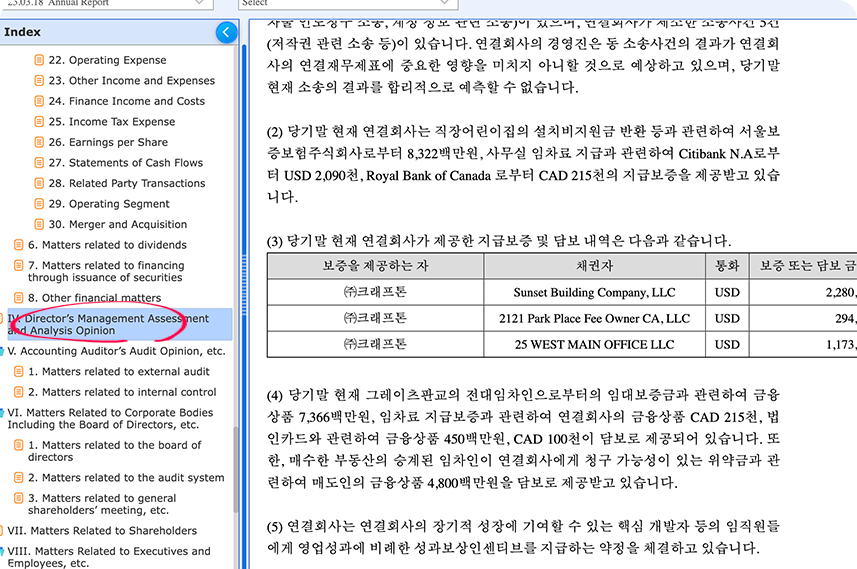
Every report has a dedicated section on risk assessment. Navigate to IV. Director’s Management Assessment & Analysis Opinion.
This section reveals if a company understands its own weaknesses. Companies that are in trouble often show one of two extremes: either they downplay risks, or they suddenly start using vague language like "향후 불확실성" (future uncertainty) and "가능성" (possibility) more frequently than in previous years.
What to do: Compare the risk language in this year's report to last year's report. If the language has become more vague, that is a signal.
A company that cannot explain how it will survive its own acknowledged risks is one you may have to watch out for.

Red Flag 3: Headcount and Salary Data
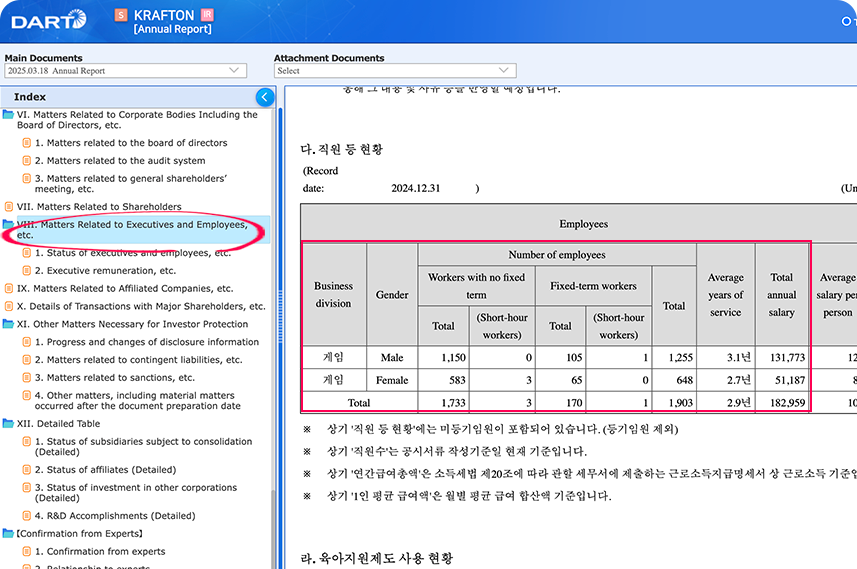
The most direct layoff signal is in the 임원 및 직원의 현황 (Executive and Employee Status) section of the annual report. Navigate to VIII. Matters Related to Executive and Employees etc.
This section discloses:
- Total number of employees and their breakdown (full-time, contract, etc.)
- Year-over-year change in headcount
- Average annual salary
- Executive headcount changes
What to look for:
- Headcount declining over 2+ consecutive years without a clear business explanation
- Contract and temporary worker ratios increasing while full-time headcount shrinks
- Average salary dropping despite inflation

Have you ever joined a company that started laying off people shortly after?
Share your experience in our KOVE community, and help other people make smarter, safer career decisions in Korea.