

How to Find Korean Jobs Worth Applying To Using One Claude Prompt
Stop mass-applying to Korean jobs. Use this Claude prompt to score your fit, predict interview chances, and see if a role is even worth your time.


You've probably been mass applying to Korean job without any callbacks.
A better move is to figure out, honestly, which roles you actually have a shot at, then put the real effort into those. That's exactly what this Claude prompt does. You paste in your resume and a Korean job description, and it tells you how likely you are to land an interview for that specific job, where you're strong, where you're weak, and whether it's worth your time at all.
What the prompt actually does
Think of it as a pre-screening round you run on yourself before the recruiter call. The prompt evaluates how well your profile matches one Korean job description. It looks at your experience, your skills, and the hard filters that decide most foreign applications in Korea.
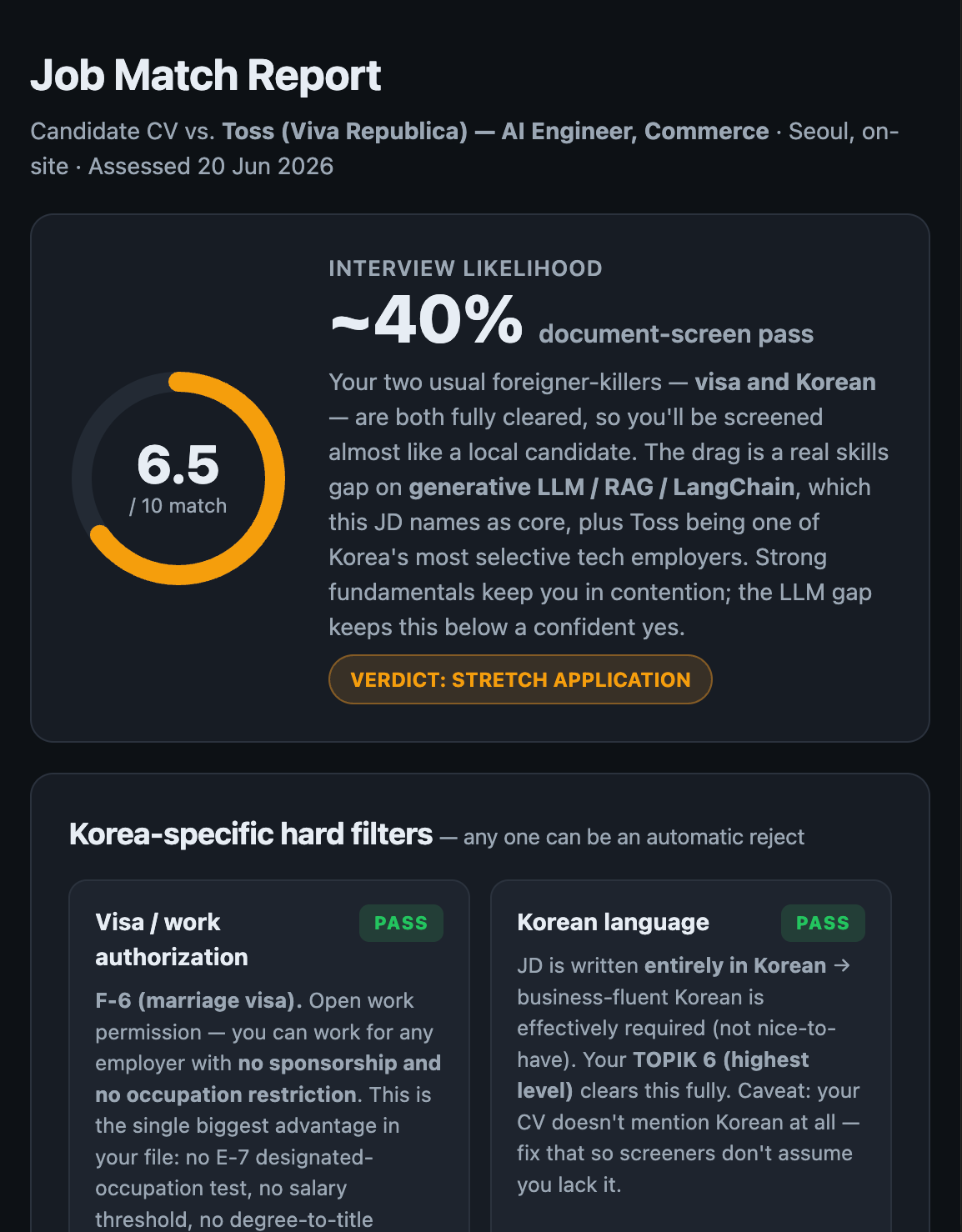
You get a match score out of ten, an interview likelihood as a percentage, and a breakdown of which requirements you cover and which you don't. Here’s a sample match analysis below:

Why I made this prompt specific to Korea
A generic rate my profile to this job description prompt doesn’t cover what Korean companies are looking for. In short, they want to check for these evaluations against a foreign candidate:
- Visa and work authorization. If you hold an F-2, F-4, F-5, or F-6, you don't need sponsorship and your chances are greater. If you need an employer-sponsored E-7, the job title has to map to a designated occupation, and your degree and years of experience need to back it up.
- Korean language. The prompt will evaluate whether the JD has a specific TOPIK requirement and evaluate your profile based on your current Korean language level.
- Company type. A multinational with a Seoul office is far more open to foreigners and more likely to sponsor. The prompt infers which one you're looking at and adjusts your realistic odds accordingly.
How to use it in under five minutes
Open a new chat in Claude. Paste the prompt below. Then drop in your resume, the job description, your current Korean language level and your visas status.

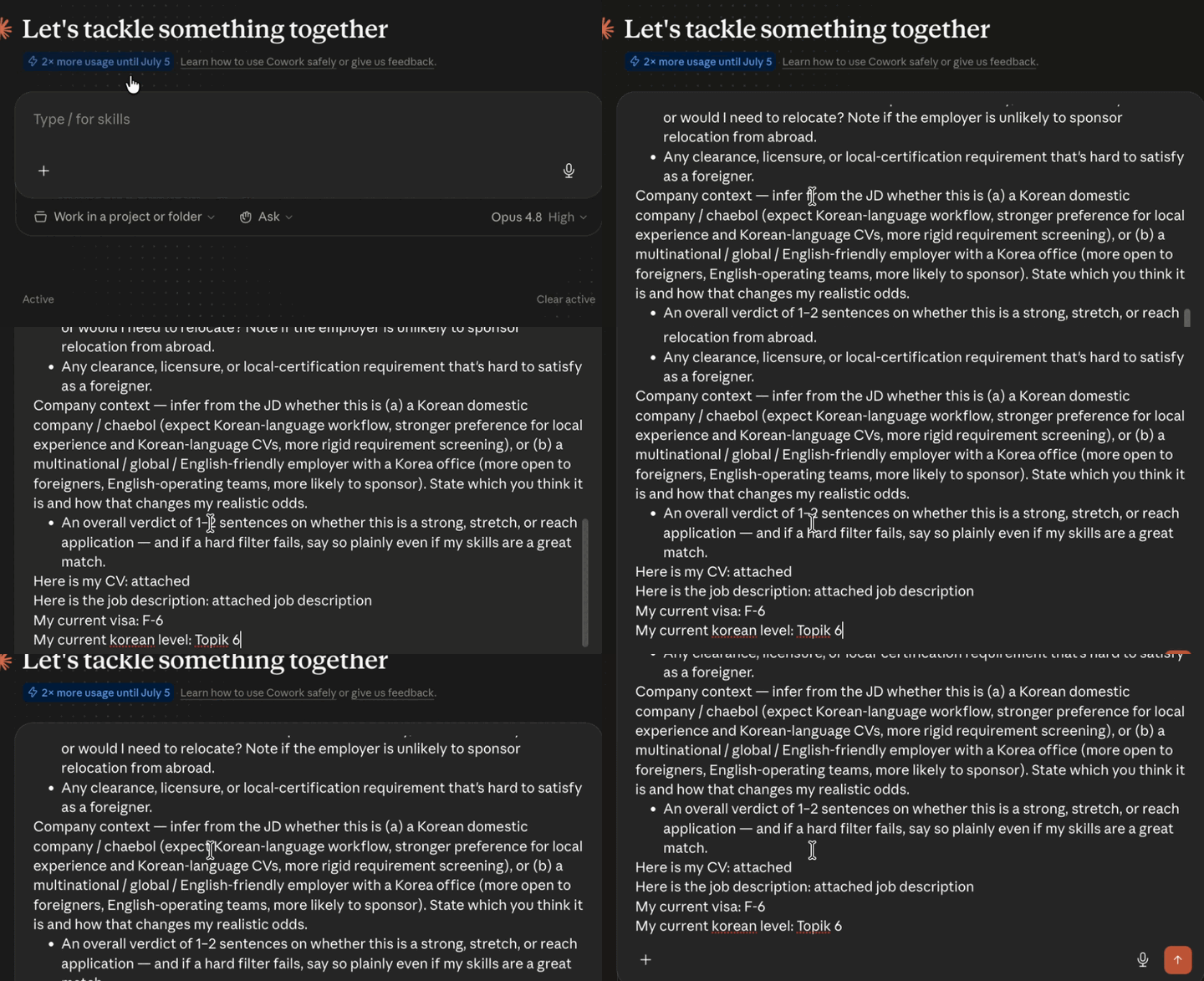
Copy and paste the prompt below:
I need an honest job match analysis for a role based in Korea. I'm going to share my CV and a job description. Be realistic about how Korean employers and immigration rules actually filter candidates — don't inflate the score to be encouraging.
Please produce a visual Job Match Report as an HTML artifact that includes:

A match score out of 10 (be honest, don't inflate it)
An interview likelihood percentage with a brief rationale, factoring in how this specific type of employer hires (see company context below)
A bar chart showing how well my CV covers each key requirement from the JD — and include Korean language and visa/work eligibility as their own scored bars
3–4 specific strengths with evidence from my CV
3–5 honest gaps or concerns

Korea-specific hard filters — flag each of these separately and explicitly as PASS / FAIL / UNCLEAR, since any one can be an automatic reject regardless of skill fit:

Visa / work authorization — Do I already hold a visa that lets me work for this employer (e.g. F-2 / F-4 / F-5 / F-6, which need no sponsorship), or would I need the employer to sponsor an E-7? If E-7: does my degree + years of experience plausibly match the job title (E-7 is tied to a designated occupation and usually wants a relevant degree and/or several years' experience), and does the salary likely clear the E-7 threshold? If I'm on a D-10 job-seeker or working-holiday visa, note the time limit. If my status is unknown, flag it as the single most important thing to clarify.
Korean language — What level does the JD actually require (none / conversational / business-fluent / native), and how does my stated level (incl. TOPIK if mentioned) compare? Distinguish "nice to have" from "you will be rejected without it."
Location — Is the role on-site in a specific Korean city, and am I already in Korea or would I need to relocate? Note if the employer is unlikely to sponsor relocation from abroad.
Any clearance, licensure, or local-certification requirement that's hard to satisfy as a foreigner.

Company context — infer from the JD whether this is (a) a Korean domestic company / chaebol (expect Korean-language workflow, stronger preference for local experience and Korean-language CVs, more rigid requirement screening), or (b) a multinational / global / English-friendly employer with a Korea office (more open to foreigners, English-operating teams, more likely to sponsor). State which you think it is and how that changes my realistic odds.

An overall verdict of 1–2 sentences on whether this is a strong, stretch, or reach application — and if a hard filter fails, say so plainly even if my skills are a great match.

Here is my resume: [attach resume]
Here is the job description: [paste JD]
Here is my Korean language level: [TOPIK level or KIIP or briefly describe your level]
Here is my visa: [Visa type or say no visa]
The takeaway
Two things will save you the most time. First, run this before you apply, not after you've already sent applications. Second, go over the analysis. If the report says your visa won't clear for that E-7 role, understand the reasonings and what you need to do to get there.
Run the prompt on your next listing and see where you actually stand.