

Stop Losing Money on Korean Taxes: Choose the Progressive Tax Rate
If you make under 100 million KRW in Korea, you might be overpaying on your taxes. Learn the difference between the flat tax rate and the progressive tax rate (누진세율) to save thousands.

Did you know that you could be losing out on up to 10% of your income just because nobody taught you how the Korean tax system works? If you make under 100 million KRW (roughly $75,000 USD) and you simply agreed to whatever your company suggested, there is a high chance you are leaving thousands of dollars on the table.
Let’s break down exactly why this matters and how you can put that hard-earned money back into your own pocket.
Based on: Official National Tax Service (NTS) English Portal
The Two Tax Systems: Flat Rate vs. Progressive Rate
When you get hired as a foreign resident in South Korea, your HR representative will usually ask you a confusing question. They will ask whether you want the "flat tax rate" or the "progressive tax rate" applied to your monthly salary. Because the terminology is confusing, most expats guess or just follow HR's default recommendation.
Here is exactly what these two options mean:
The Flat 19% Tax Rate (단일세율)
This is a special, foreigner-only option provided by the Korean government. If you choose this, you pay a flat 19% tax on your gross income. It sounds like a VIP expat perk because it is incredibly simple to calculate. However, simplicity comes with a massive downside. You do not qualify for most standard tax deductions.
The Progressive Tax Rate (누진세율)
This is the standard tax bracket system that local Korean citizens use. Your tax rate increases gradually as your income goes up. More importantly, this system allows you to participate in the famous "Year-End Tax Settlement" (연말정산). This means you get deductions for everyday expenses like credit card spending, medical bills, rent, and public transit.

The 50 Million Won Example: Run the Numbers
That flat 19% option feels like a great benefit at first glance. However, if you actually run the numbers, it often puts you at a severe financial loss when your salary is below 100 million KRW, which is where the vast majority of expat professionals fall.
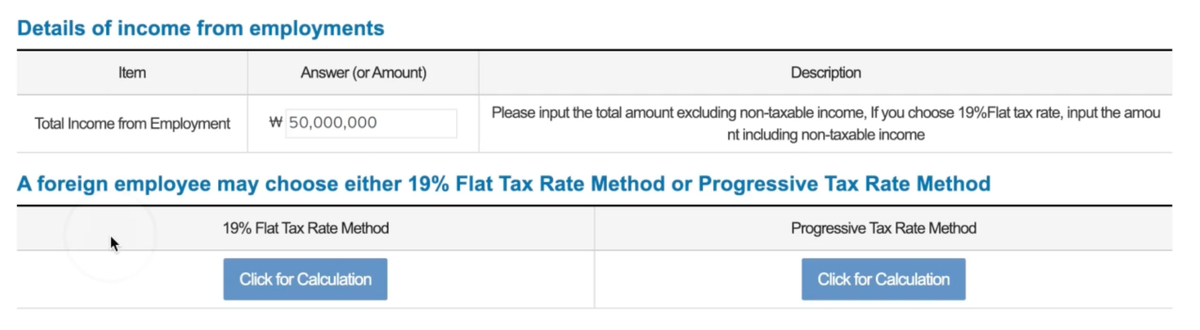
Let us look at a simple comparison. Imagine your annual salary is exactly 50 million KRW.
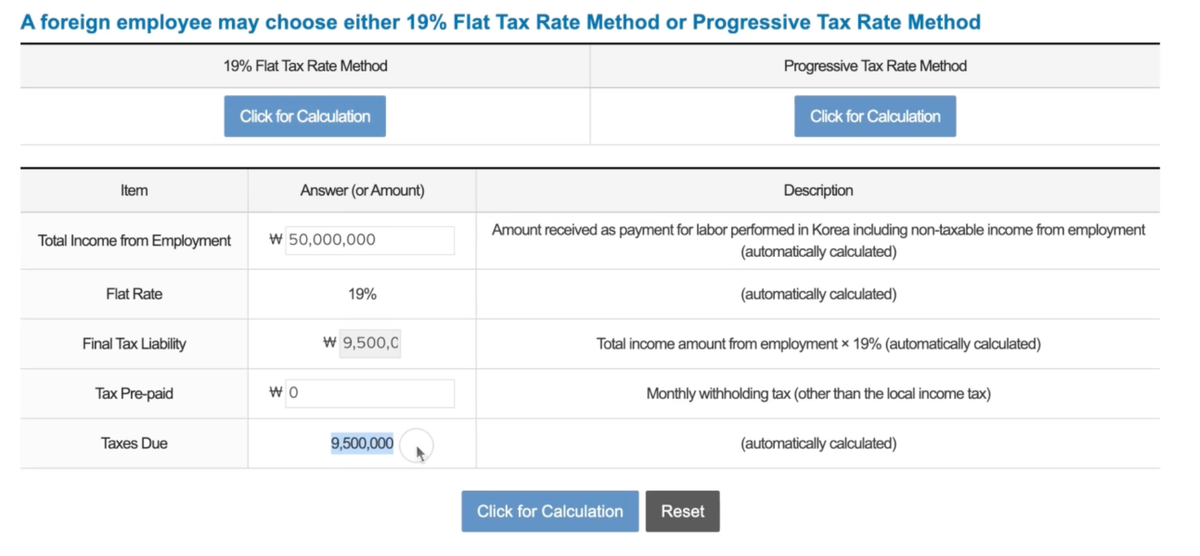
If you are on the flat 19% system, the government calculates your tax without any deductions. You will owe approximately 9.5 million KRW in income tax for the year.
Now, let us imagine you switch to the progressive system. Because your income falls into a lower starting tax bracket, and because you can input basic deductions like your daily cash and card spending, your estimated tax burden drops significantly. Your final tax bill could drop to around 4 million KRW.
By simply choosing the progressive rate, you save over 5 million KRW. That is equivalent to a 10% bump in your take-home pay!

When is the Flat Rate Actually Better?
To be completely fair, the flat tax rate is not a scam. It is simply designed for a different demographic.
If you are a high-level executive or a specialized engineer earning well over 100 million KRW, your income would normally push you into Korea's highest tax brackets (which can reach up to 45%). In that specific scenario, capping your maximum tax liability at a flat 19% is an incredible financial advantage.
But if you are under that elite income range, like most foreign teachers, office workers, and mid-level managers here, the progressive option with standard deductions is usually what puts the most money back into your pocket.
Summary and Next Steps
Do not let intimidating financial terms stop you from claiming your full salary. Taking control of your Korean taxes only requires a few simple steps:
- Check your pay stub: Ask your employer or HR department which tax system you are currently enrolled in.
- Make the switch: If you make under 100 million KRW and are on the flat rate, clearly tell them to switch you to the progressive tax rate (누진세율).
- Prepare for tax season: Keep track of your spending and prepare to file your Year-End Tax Settlement (연말정산) in January or February to maximize your refunds.
If you want to know exactly how much you could save, you do not have to guess. The Korean government provides an official English calculator to help expats run their own numbers. Check out the official NTS calculator here: National Tax Service Year-End Tax Calculator.